Product
Why Legal AI Needs to Work in Context, Not Just in Isolation
A system that waits to be prompted puts the burden back on you. The right standard is initiative — understanding what a matter needs before you ask.
 Jakub IdziakApr 14, 20268 min
Every conversation about legal AI eventually gets back to the same problem: lawyers are still doing the work of coordination, triage, and follow-up that no amount of prompting can offload. The tools improved. The job description didn't.
There's a particular kind of cognitive tax that builds up across a working day in a legal team. It's not the hard thinking — the analysis, the judgement, the client relationship. It's the overhead that accumulates around it. Which documents are still outstanding. Who needs to review before Thursday. Whether the counterparty's redline from two weeks ago was actually addressed. None of this requires legal expertise. All of it takes time.
The first generation of legal AI tools addressed a real bottleneck — drafting, research, first-pass review — but they addressed it narrowly. They made individual tasks faster without changing the structure of the work. A lawyer still has to know what needs doing, decide to do it, open the right tool, and prompt it in the right way. The loop is shorter, but the lawyer is still at the center of it.
What "working in context" actually means
Context, in this sense, is not about what the AI knows in a general sense. It's about what a matter needs right now. That's a different kind of intelligence. It requires understanding the current state of the deal or file, who's responsible for what, where the blockers are, and what the next step is — without being asked to figure any of that out each time.
A system that has that context can do more than execute tasks. It can raise the right issue before it becomes a problem. It can draft the follow-up before the lawyer remembers to send one. It can flag that a signature is still missing three days before closing, not the evening before.
"The right standard for AI in law is initiative, not just accuracy."
The integration problem is still underrated
One reason standalone AI tools hit a ceiling is that legal work doesn't happen in one place. It happens across email, document systems, task lists, and conversations — often simultaneously across multiple matters. A tool that only knows what you paste into it is necessarily a partial solution.
That's not an argument against those tools — it's an argument for something that ties them together. The value of AI in a legal team isn't locked in any one capability. It's in the connective tissue: understanding which capability is needed, when, and applying it without being told.
Andy works inside Microsoft Teams — where legal teams already coordinate. Rather than pulling lawyers into a new tool, it meets them inside the workflow they already use and acts on what it observes there.
This matters because adoption in legal teams is notoriously difficult. New software competes with existing habits, institutional inertia, and a professional culture that rightly treats change as risk. A system that reduces friction rather than adding new surfaces is far more likely to actually change how work gets done.
What this means in practice
For a lawyer on a deal, it means the closing checklist gets started before they ask for it. The NDA first draft appears when the counterparty is first mentioned in the thread, not a day later when someone remembers. The outstanding items surface in a morning message rather than accumulating silently in the background.
None of that replaces legal judgement. It creates the conditions for better legal judgement — by clearing the overhead that crowds it out. That's the distinction worth holding onto as the category matures: AI that makes lawyers faster at doing tasks, and AI that changes what lawyers have to hold in their heads at all.
Jakub Idziak
Founder & CEO, Paremy
More from the blog
All posts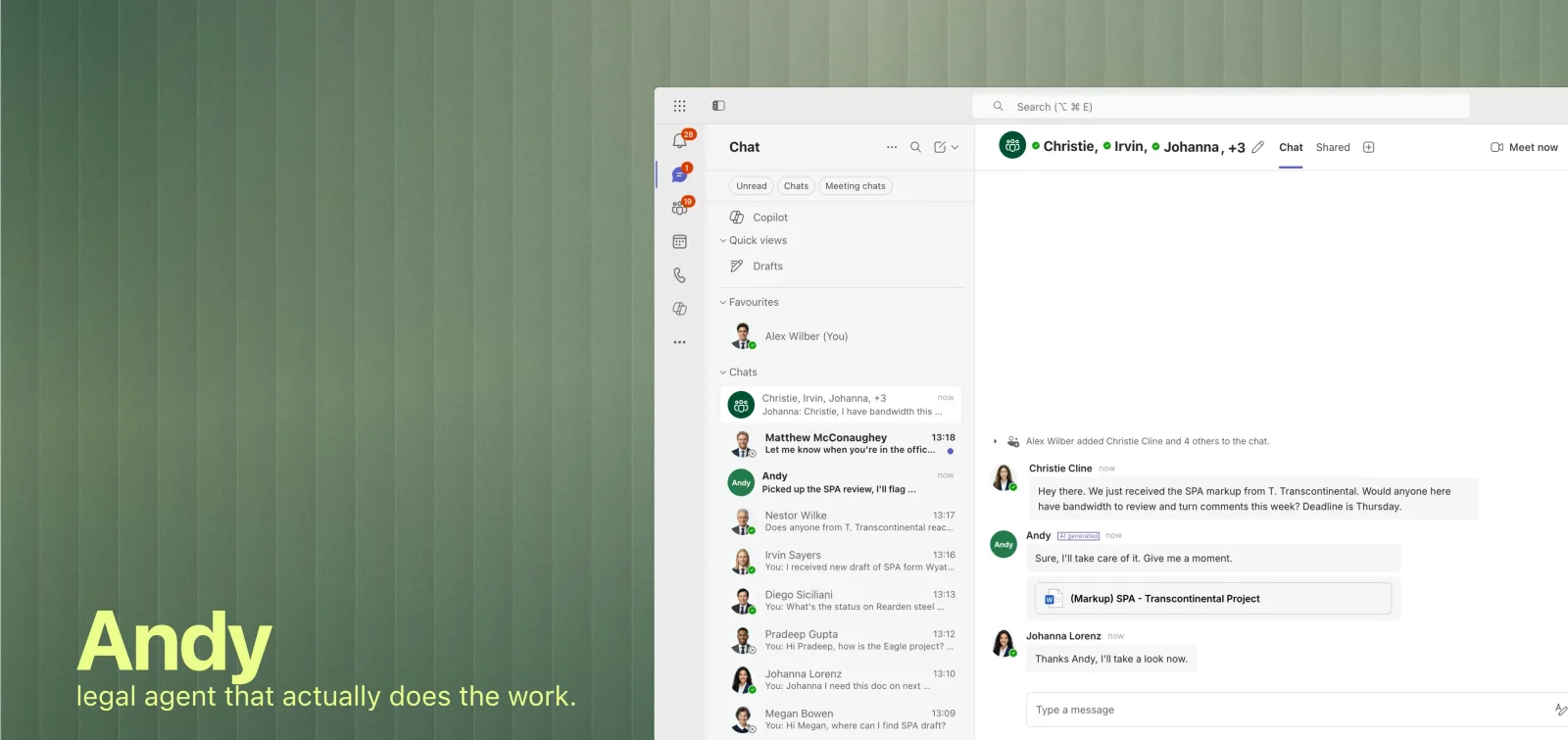
Announcement
Meet Andy
The legal agent that actually does the work. Introducing a new kind of AI built for legal teams, one that takes initiative, not just instructions.
June 10, 2026 · 5 min
Product
How Andy Reads a Matter Thread Before You Ask It To
A look under the hood at how contextual awareness is built into the core of how Andy operates.
May 28, 2026 · 4 min
Legal Ops
The Closing Checklist Shouldn't Start With You
Why deal management is the clearest proof-of-concept for proactive legal AI — and what good looks like.
May 14, 2026 · 5 min
Ready to give your team their time back?
Book a demo and see Andy in action. Or just reach out and we'll take it from there.